
Jimmy Ates
Incident Date: 1991
Jurisdiction: First Judicial Circuit
County: Okaloosa
Charge: Murder
Conviction: Murder
Sentence:
Year of Conviction: 1998; convicted again following retrial in 2011
Release Date: March 11, 2021
Sentence Served: More than 20 years
Real perpetrator found?
Contributing Causes: Withheld Exculpatory Evidence, Invalid Forensic Science
Compensation? No
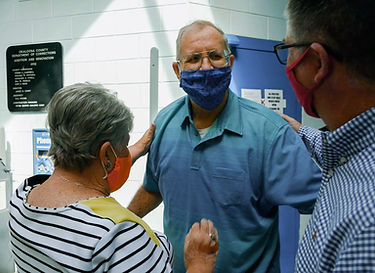
On March 11, 2021, Jimmy Ates was released from the Okaloosa County Jail after spending more than 20 years wrongfully incarcerated. Ates entered a no-contest plea that did not require him to admit guilt and allowed him to continue maintaining his innocence, as he had since his wife was murdered in 1991. His release followed nearly 30 years of litigation and two overturned convictions.
The Crime
In 1991, Jimmy Ates’s wife was tragically murdered. Evidence indicated that Ates was at work at the time of the murder, and additional evidence suggested that other individuals committed the murder and robbery.
Despite this evidence, Ates was convicted of his wife’s murder in 1998. His case would ultimately reveal serious problems involving both scientifically invalid forensic evidence and exculpatory evidence that was withheld from his defense.
The Trial
Ates’s original conviction relied in part on forensic conclusions that were later determined to be scientifically invalid. The State also failed to disclose an exculpatory fingerprint found on a key piece of evidence.
In December 2008, the Innocence Project of Florida successfully won a reversal of Ates’s conviction based on the State’s failure to disclose the fingerprint and its presentation of invalid forensic conclusions. Ates became the first person in the nation to have a conviction overturned based on the FBI’s disavowal of Comparative Bullet Lead Analysis (CBLA). Ates was released pending a new trial but was convicted again in 2011.
Withheld Evidence
Two years before Ates’s second trial, law enforcement had a confidential informant record a conversation with an alternative suspect in the murder. During that conversation, the murder of Ates’s wife was discussed as a “robbery gone bad,” with no mention of Jimmy being involved.
At a 2018 hearing, the confidential informant testified under oath that the alternative suspect had confessed to killing Ates’s wife and that she had informed law enforcement about the confession before Ates’s 2011 trial. This evidence was withheld from Ates’s trial attorneys and was not disclosed until more than three years after his second conviction.
The Okaloosa County judge ultimately overturned Ates’s conviction for a second time, finding that material exculpatory evidence had been withheld and that failing to disclose the recording prevented the defense from locating, interviewing, and presenting the confidential informant.
Post-Conviction
After having two convictions overturned, Ates, then 74 years old, faced the possibility of an unprecedented third trial. Nearly 30 years had passed since his wife’s murder, and he had already spent more than 20 years incarcerated.
Given his age, the uncertainty surrounding when another trial could take place during the COVID-19 pandemic, and the risk of continuing through the criminal legal process, Ates entered into an agreement with the State. The agreement allowed him to maintain his innocence while securing his immediate release and the opportunity to spend the remainder of his life in freedom.
On March 11, 2021, Jimmy Ates walked free from the Okaloosa County Jail.
“Jimmy Ates has maintained his innocence since his wife was murdered in 1991,” IPF Executive Director and attorney Seth Miller said at the time of his release, adding that the resolution allowed Jimmy to return immediately to his family rather than face continued uncertainty in the proceedings.
Ates was represented by Seth Miller of the Innocence Project of Florida, along with Joshua Tepfer, Karl Leonard, and Tara Thompson of the Exoneration Project. IPF Staff Investigator Jennie Nepstad conducted critical field investigation, and former IPF Staff Attorneys Bobbi Madonna, Melissa Montle, and Krista Dolan also represented Ates during his case.
